GIANT ATOMS

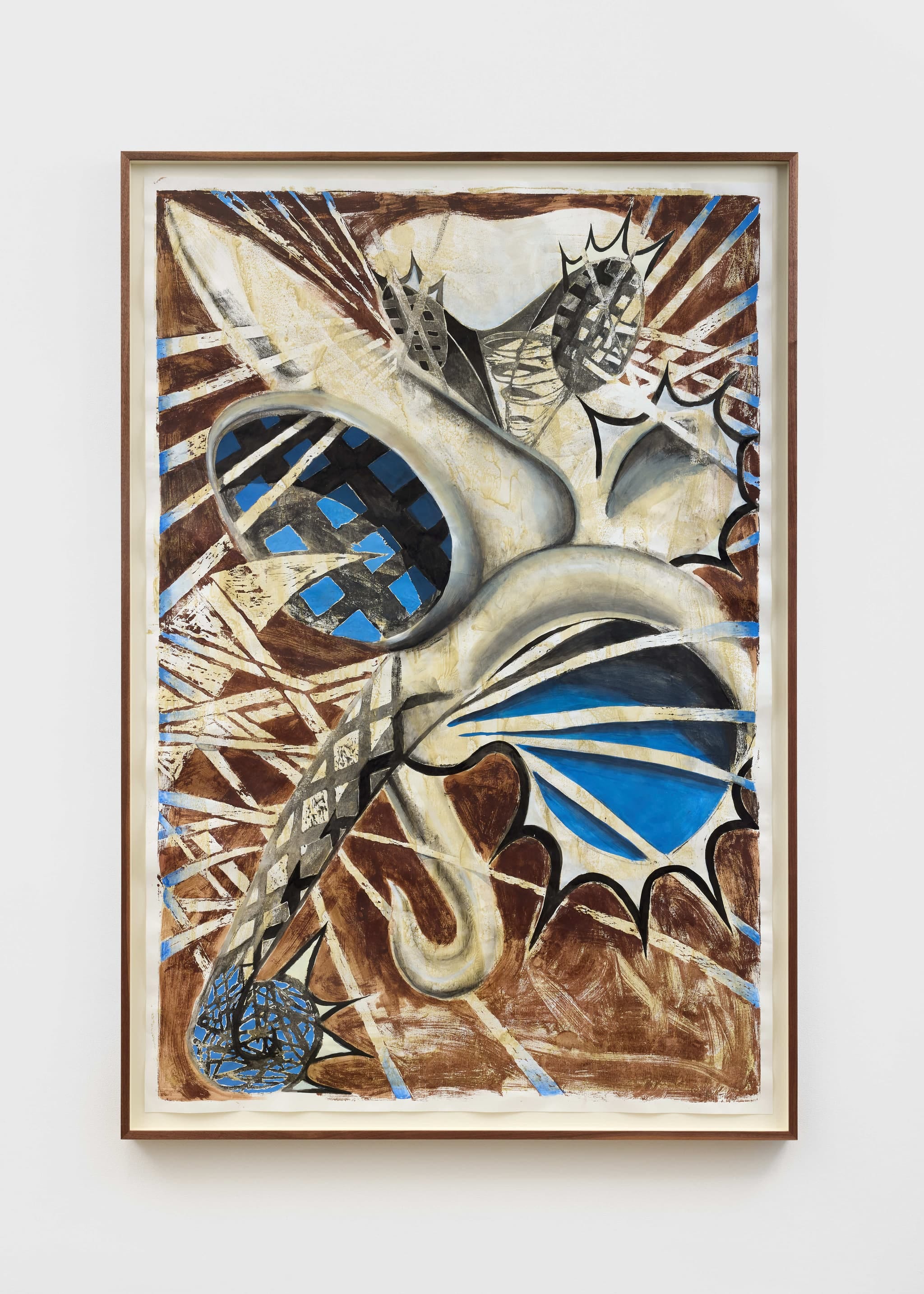
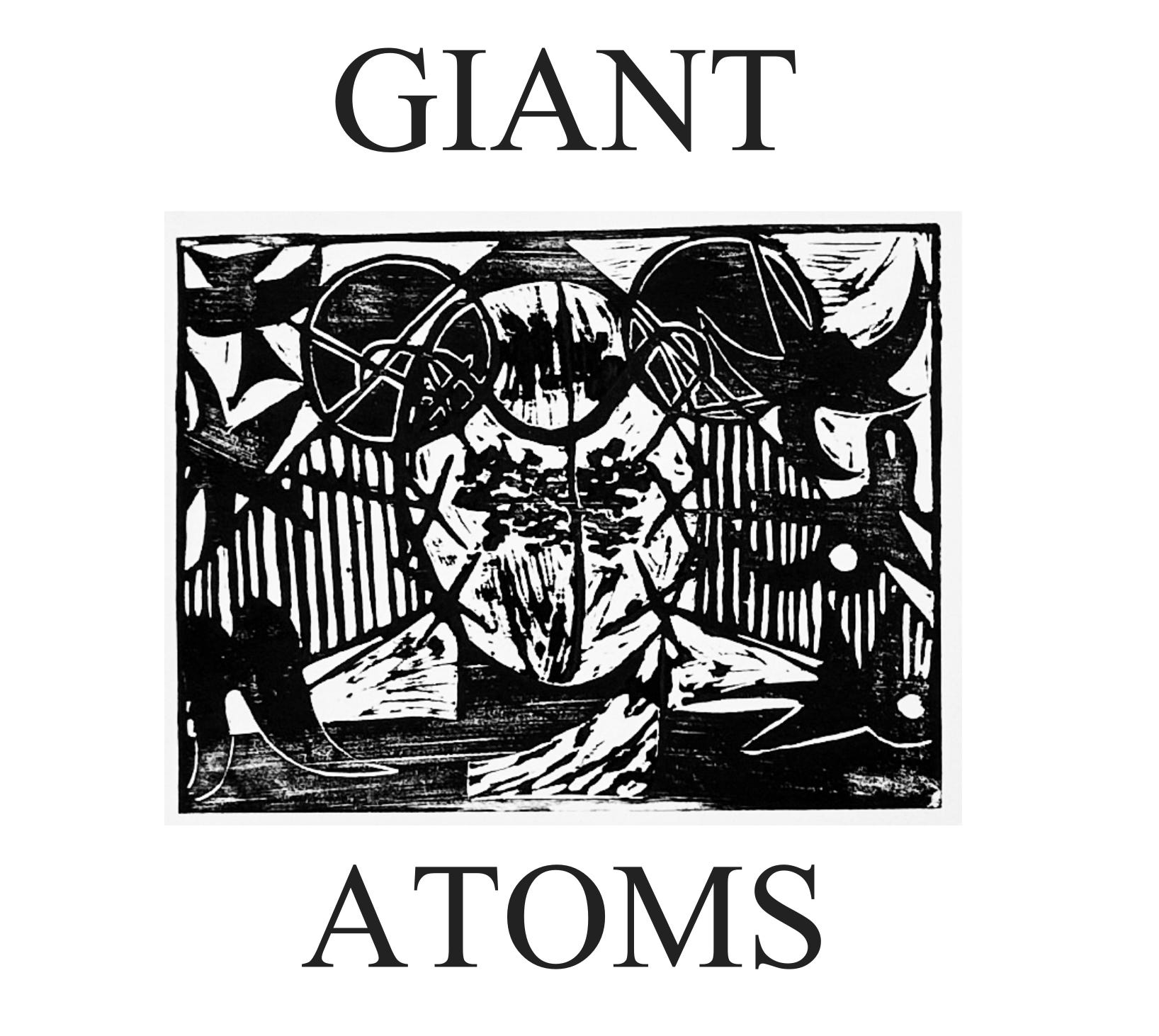
The following is a text to accompany my exhibition of woodcut prints called ‘GIANT ATOMS’ at Project Native Informant in London. The exhibition runs until the 5th July.
It was a relief to learn about Schelling and Novalis, who wrote in ecstatic style that art was the "organ of philosophy." It spurred an awkwardly late realisation in me: that I'm a Romantic like them.
Darwinian evolution suppresses our awareness of nature, its orchestral simultaneity. If dinosaur bodhisattvas had existed, they would be an easy lunch and deleted from the gene pool. Therefore, we are caught in the glue-trap of details. The godhead of the universe, which oscillates in some hinterland of endless geometric superposition, is anaesthetised by our sensorium. It's fortunate; we wouldn't be people, but angelic plasma that couldn't find food. As Blake said, "If the doors of perception were cleansed everything would appear to man as it is, infinite."
Art, however, thrives un-cleansed. It gladly wallows in the slurry of terrestrial ingredients. Rather than anointing the doors of perception with ablutions, it excoriates them with wattle and daub telescopes or divining rods. Somehow, in its meandering drowsiness, art wriggles through a maze that begins in variegation and winds home into universality. It's a mystery. Therefore, the custom of labelling art with subject matter has always struck me as rather flimsy. Artists don't choose their subject; they are the subject! Their imagination conducts the palpitating voltage of nature. As Cezanne said, "The landscape thinks itself in me, and I am its consciousness." All attempts to truly picture nature are necessarily incomplete, as they are done from the finite, the inside. Artists are therefore hamstrung from the start; indeed, embarrassing failure is a competency they must cultivate. Mistakes or misregistrations of an artist's materials disrupt the habitual correspondences between language and perception.
To our constrained minds, the scale of nature is absurdly huge. Giant systems have a phosphorescent quality all of their own—too many googolplexes to count. Is their giant-ness not akin to sacredness? This is why in the great wisdom traditions, the more grandiose the metaphysical striving, the more acute its inverse law: confounded bemusement. The most enlightened sages were to their contemporaries mad cranks: think of Hanshan, Alexander Grothendieck, or Van Gogh. What words other than 'soul' or 'personae' are appropriate to characterise the computational idiosyncrasy of nature which these figures described? In the spirit of romanticism, isn't it the artist's duty to ascribe in vain a shape, colour and frequency to the 'set of all sets'? Yet the face of God is best depicted as a humble plate of quince and apples, the colour blue, even the dirty-minded scribbles on the bathroom wall. Extreme specificity somersaults into totality. The whole is encrypted in the myriad parts and blooms amongst opposites.
This all sounds rather grandiose and absolutist, but art is a more universal or general phenomenon in nature than we think. It's not an 'invention' of human beings, but rather a replicating pattern that possesses them. Painting, sculpture or cinema are expressions of this volition of art being implemented in human technology, but there are surely whale poets using mournful clicks, whoops and hums. Their cetacean amygdala are seven times larger than a human’s, perhaps experiencing more profound aesthetic phenomena than us primates. There are family resemblances to art latent in the information flows of more abstract giant systems: the structure and attractors in the trillion weights of a GPU mega cluster, or the skyscrapers of phytoplankton in the water column swapping genes. There's a stickiness and self-interestedness in these vast currents of information, a blind striving to form semiotic representations and increase complexity.
Art and poetry will soon be studied by computer science the way biologists study bacteria—as a species of intelligence that sits awkwardly against the current nomenclature. It's my (amateurish) hunch that the future filled with powerful AI won't be such a simple story of exponential utility maximisation. Art undoes these labels; what's utility? What's maximisation? Perhaps artworks could be characterised as a technology to achieve maximal conscious openness, and if art has a utility, it's an intrinsic one. Art is a kind of living organism with its own goals, a parasite from the shadowy realm of the potential and unformed. When artists try to impose external goals on their work the result is propaganda or advertising, and art dies off. The best artists willingly allow themselves to be deleted by their work. Of course, art has useful social functions—those are part of its adapted replication apparatus - autonomous behaviour in the same way sporing fungi can possess ants to climb trees.
There's a dogma of embarrassment in the West about attempting to picture the absolute or the ineffable in nature. But the pedagogy of 'critique' over and above wonderment is just kerosene on the bonfire of the culture industry. Baudelaire called artists ‘cottage-brained’ - he was right. We should all realise the good, the true, and the beautiful are weirder and richer than we can quantify.