Fat and Silver

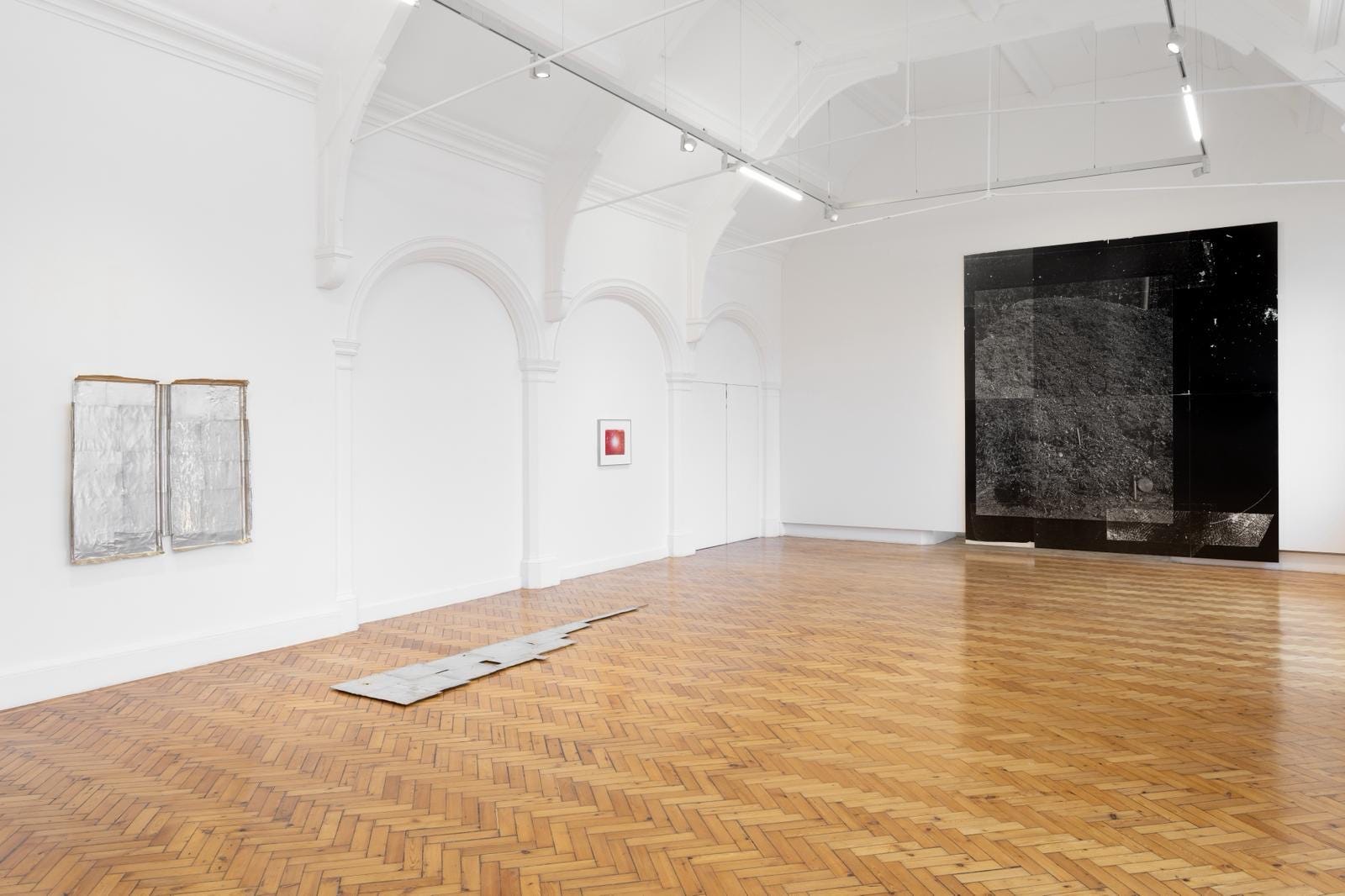
The following is an essay to accompany Nat Faulkners exhibition ‘Strong Water’ at Camden Arts Centre in London and is printed in the exhibitions publication ‘1:1’.
The exhibition continues until 22 March 2026
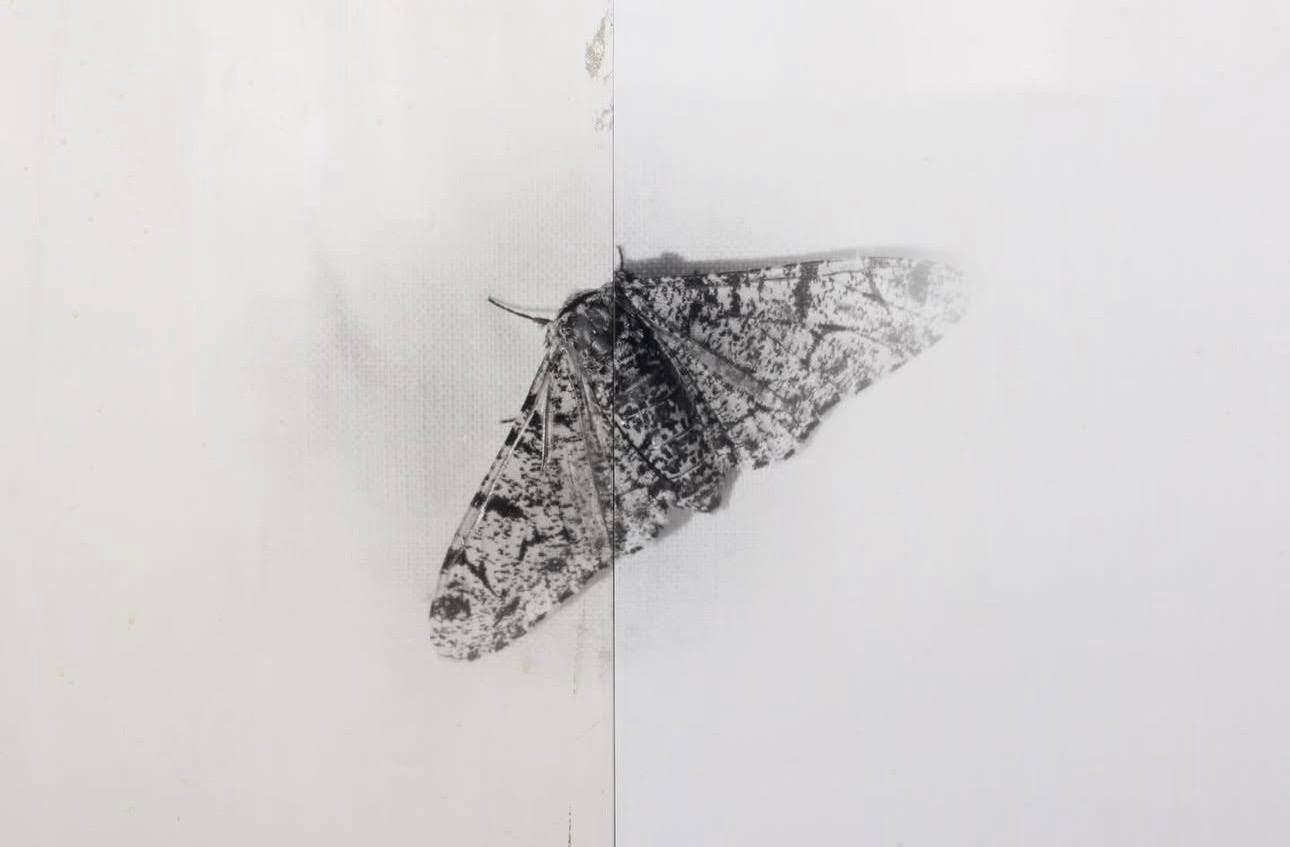
Untitled (Biston betularia), 2026, Silver gelatin print on plywood panel, aluminium tape, white paint, 160 × 200 cm
If God can be credited with a nanotechnological masterstroke, then it is her creation of Fat.
The unctuous yellow and brown jelly which grows subcutaneously in animals is a battery of solar energy; an ambrosia of concentrated nutrition for any critter lucky enough to eat it. For millennia fat was the primary art material of hominids; its rendered grease holding paint pigment or smeared with blood on figurines – a mixture of utility and magical transference. Is not the appeal of oil paint its mimicry of fattiness? Rembrandt painted in lard and ice cream. Even today, liquified cattle bones are used to develop analogue photographs, trapping photons in marrow.
There’s a frantic yearning to consume fat; few other substances release such a dopaminergic joy. The carnivorous satiation it elicits is so pervasive it climbs out of the digestive and into economic infrastructure. Large chunks of the global economy trade in it; consider the vicious decimation of whales throughout the 18th century, their blubber shipped from Nantucket and New Bedford, destined to sputter in oil lamps. Even now, the size of the pork economy is worth more than the global art market five times over. Earthy and sweet, storing it in the human subdermal tissue telegraphs a primal display of virility. It is knitted into the tactile and somatic map of our experience; most readers will have the infantile recollection of safety, nestling into the fat of their parent or grandparents’ bodies. Perversely, as the global adoption of camera technology exponentiated, fat became a taboo and is regarded as repulsive. Fat’s intrinsic signal of plenitude and energy conservation undermines capitalism’s dependence on narratives of scarcity.
Therefore, colloquially we think of fat as a material as being rather uncomplicated and base, but its little molecules called lipids scaffold a huge degree of biological complexity. Lipids are shaped like comets or the Sputnik probe, a globular head atop a stringy tail. The head seeks water; the tail fibres are repulsed by it. Walls of these molecules click together to form cell membranes, architecting a stark distinction between inside and outside. This propensity for enclosure is akin to what philosophers like Deleuze or Bergson knotted their brains with: ‘difference’. In the early oceans billions of these tiny spheres formed the first interior spaces. Within these little wombs of fat, the planet’s first proto dreams or pictures occurred; an intimate bristling of acid chains configured themselves uniquely for the first time, sliding the nodules of their bodies across each other, bonds rhyming or syncopating. A micellar library modelling its internal ligatures and shuffling possible configurations. As you read these words, millions of fat molecules are scaffolding your conscious experience of the voice in your head.
Regrettably, contemporary society views materials with a specious ubiquity. In an atomic weltanschauung, matter is just a numerical grocery list, a greater or lesser number of primitive components. Fat, mercury, or asphalt are a difference in degree, but not in kind; gold has seventy-nine protons and electrons, forty-seven apiece for silver. So drained of quality and engorged by quantity is our relationship to materials, that their inherent personae are reduced to cream, skimmed off by those who indulge in poetic frivolity. Qualities are generally agreed to have no metaphysical depth – a tyranny harking back all the way to Democritus. For an artist like Nat Faulkner, this is a mistake. He is closer to a Goethean romantic, or even a Victorian spiritualist, advocating for the intermixture of the world around him. He is working against the propensity in human perception to see objects but be blind to their causes. For Nat, Art should unravel nominalism like a ball of string.
Consider the eye, an organ which is extraordinarily composed of specialised fats. It evolved independently forty times in the history of life: for the ‘camera eye’, an architecture possessed by humans or arthropods, an estimated three or four times. This is an example of where a planetary system pulls forth an autonomous vision device from its soup of frothing chemicals, the geological niche repeatedly sculpting a visual system like a hyperdimensional silicone mould. One could even go so far as to say: written into the fabric of the planet is a propensity – even inevitability – for photographic experience. A simple soap bubble refracts with as much fidelity as polished glass. The principle of the camera obscura is so simple; all that’s needed is a pin prick in a surface. Countless times in Earth’s history, little magic lanterns must have flashed and faded: a tear in a big leaf, projecting the sky against a prehistoric tree trunk. The planet is a system that longs to picture itself!
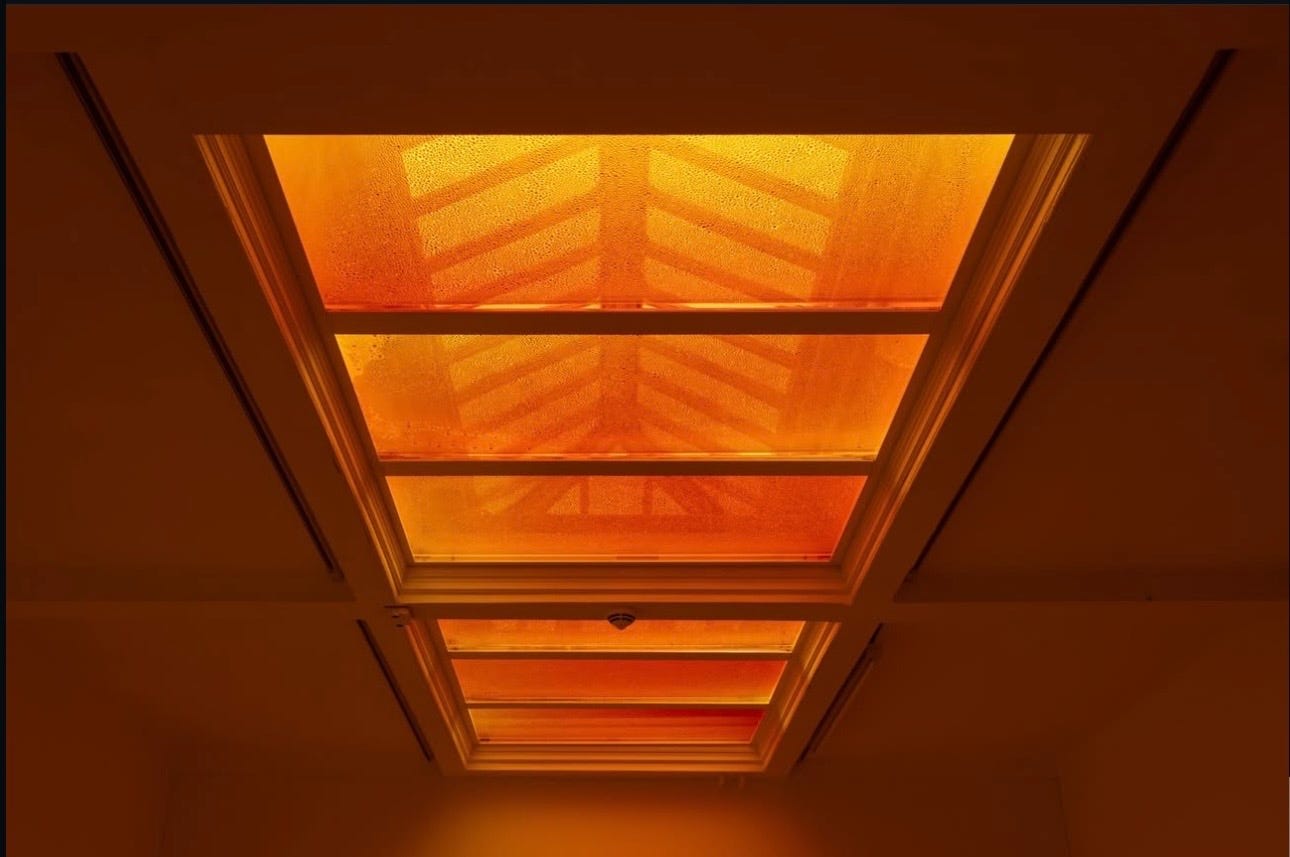
‘Aperture (iodine)’, Iodine and Acrylic frame, Dimensions variable
Written in his ‘Optics’, Descartes describes slicing the back of a bull’s eye – as if plucked from Buñuel’s ‘Un Chien Andalou’ – he applied thin paper, so an audience could watch an inverted image formed on its surface. The invention of photography is not so much about lenses as the introduction of a memory; a substrate to fix this inverted beam of light and make it legible. The photo-graph is an inscription, its Greek roots translate to writing in light. Evolution is strongly opposed to fixing an image. Imagine vision with a much slower frame rate: it would appear as a swirl of geological formations, tracking objects would convert into stalactites or smoke trails from a flare. Moving through a room would result in tesseracts crushing in on themselves like endless paper architecture. Therefore, the photograph is suspect in its fidelity and detail, it contravenes the compressed approximations the mind makes. This invention of luminous writing, like its textual counterpart, formed a powerful new prosthetic to ordinary cognition.
Little did Joseph Nicéphore Niépce know, when he produced the first photograph, a ‘View from the Window at Le Gras’, how the world would morph into a monstrous global hydra of cameras. The little picture, baked into pewter through bitumen of Judea then wiped with lavender oil and white petroleum, was the birth of a new consciousness; an unfathomable wound opened upon the mass psyche. Photography has now quickly surpassed the camera; the aggregation of the internet has absorbed so many photographs that it can endogenously produce any image it dreams up. Billions of earth’s cameras have formed something akin to the lipid vesicles in the early ocean, their individual dream states cracked open like tiny dragonfly eggs. In their trillions, the colours and edges have poured into an oceanic slurry of data passed through the sluice of GPU mega-clusters. Photography is now in the same crisis that it caused painting. It too must now adjust to a world where it has rendered itself obsolete.
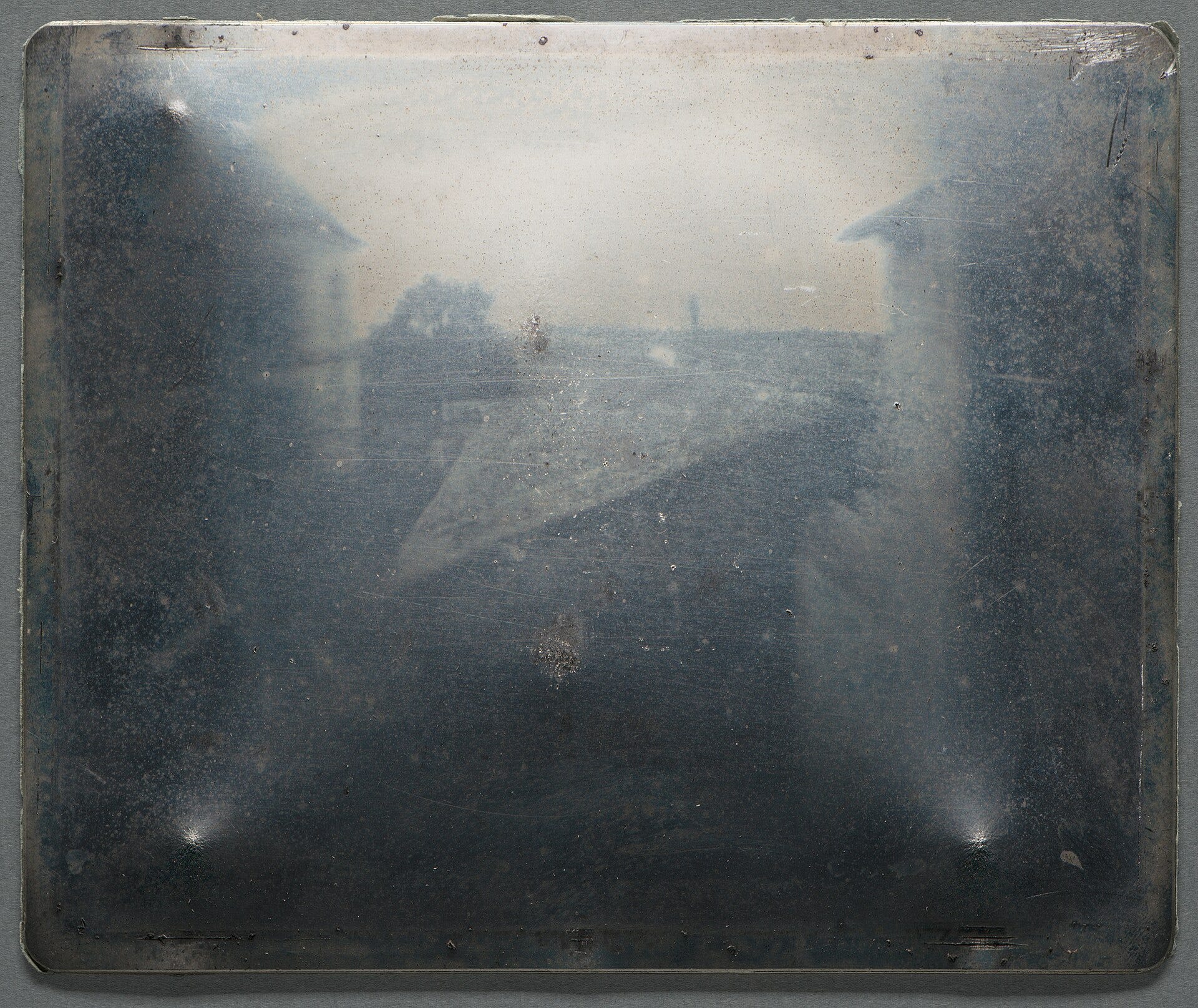
Nicéphore Niépce’s original plate of ‘View from the Window at Le Gras’, showing rooftops visible from a second-story bedroom window
In such moments of political decline and technological advancement, there is often a schism in imagining a path forward. A spiritualist impulse emerges, which decries the world as failing because it is too rational and looks to re-enchant society. This is opposed by a pragmatist and even technocratic reaction, which argues the world should care more about the facts and be even more precise. Nat is arguably caught on this boundary: candid Protestantism (each work having a reasoned and sequential throughline) – contrasted with clairvoyant action (scrabbling in the dark, sloshing chemicals in giant custom-made developer tubes). The studio becomes both a laboratory and a séance: are we witnessing evidence of the luminiferous aether? Some species of aurora that has so far eluded science? Marie Curie’s glowing vials of radium or Thomas Edison’s ‘incandescent lamps’ feel familiar to the work. The images themselves have the quality of a camera trap for animals; Nat dredges up rather than composes his pictures. The triangular or perspectival ‘capturing’ of a photograph is replaced with a yielding reception. Frottage, contact prints and gestural use of the photographic enlarger are all processes for Nat to feel some haptic feedback from images. To make the ghosts of matter and experience comingle and evidence themselves – photography as proprioception.
After all, how is the photographer to portray a world that is un-picturable by using pictures!? Contradiction is perhaps the best hope for approaching realism—photography’s inescapable burden. That which is real is frustratingly anarchic, convoluted and tricksterish. Eastern traditions capture it best: the MU of Zen is described as a screaming hot iron ball. Therefore, to capture realism is to be skilfully naïve in the right way, to be a butterfly net, a particle detector, a snare. A neutral instrument which shows rather than ascribes a story. The photographer trusts the world has enough agency to reveal itself without the need of humans; they just choose the appropriate frame of reference. What strategy exists for knowing the world beyond noticing correspondences and subtle rhymes? Doesn’t mathematics show that seemingly dissimilar entities are equivalent?
Nat’s work has a family resemblance to the occultists or alchemists – concatenating threads of sensate correspondence and forming clunky likenesses. There is a whisper of both knowledge and folly in ascribing a realism to that which rhymes: rhyming transgresses ordinary syntax and forms novel bonds of connection. A sorcerous logic. This is also a biochemical rationale; isn’t the active site of an enzyme a rhyme? Rhymes are often productive, they spit forth an excess, a third thing, a catalysis. This is the engine of art. In striving to know anything, the best we can hope for is local correspondence not universal perfection: an enzymatic epistemology! Even the most steadfast of scientific facts are built on soupy foundations: hypothesis and data never truly meet. Besides, art (and indeed life) is not a formal system, Descartes’ Mathesis Universalis is meaningless to disobedient materials, there are no true symmetries. What are the axioms of the detritivores? Decay and transformation are one and the same.
Thus ‘Strong Water’ is an exhibition that is a grave. A tar pit. Nat’s silver salvaged from medical X-rays carries the trace of a thousand broken bones. The giant stack of metal ribbons at a recycling plant are the hides of flayed machinery, ready to be liquified like the whale carcasses in Nantucket. Silver has an alchemical duality of the precious and the deathly; its molecules split fatty membranes apart and embalm images to paper. What ontic status do these metaphorical assertions have? They are correspondences of electromagnetic patterns, dancing on the fatty infrastructure of brains, a music of energetic shapes.